
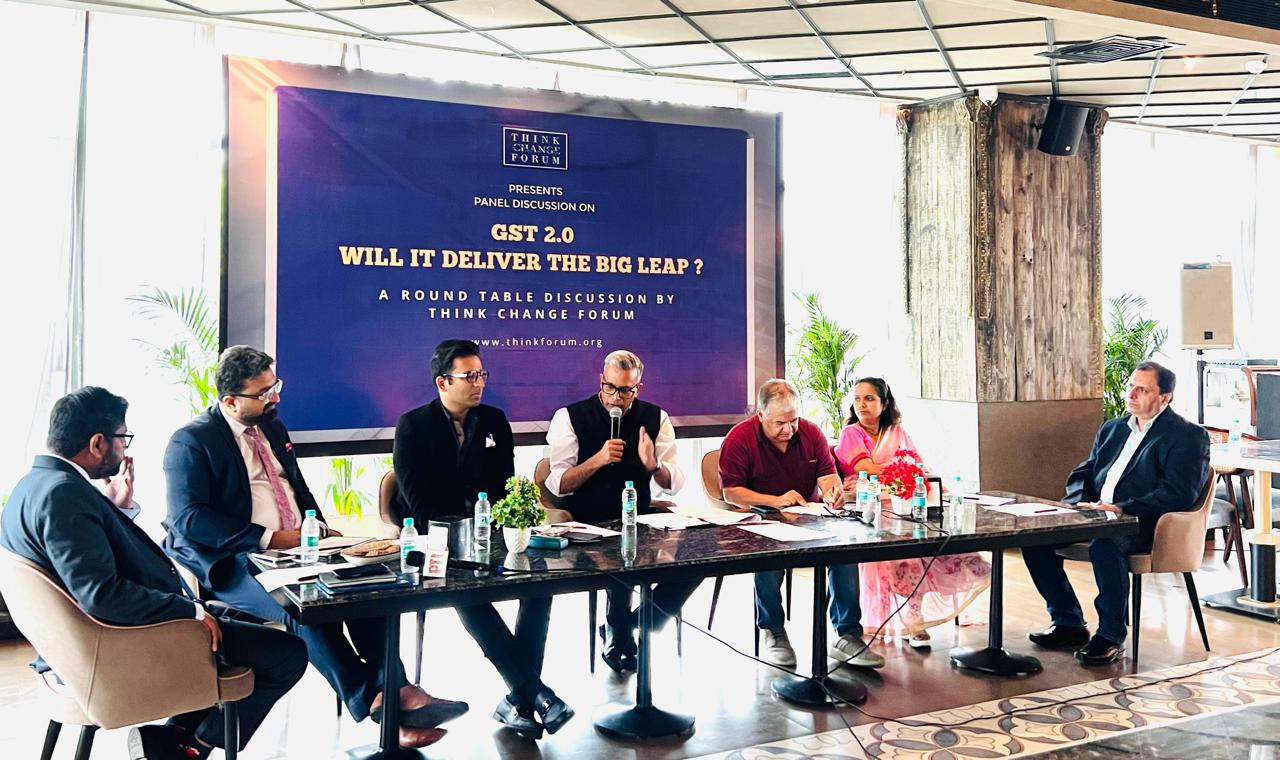
1st September 2025, New Delhi
Distinguished speakers at the event:
- Ranganath T.: Secretary General, Think Change Forum.
- Prof. Nilanjan Banik: Professor, Mahindra University & Visiting Professor, ISB.
Think Change Forum, through the release of a meticulously researched white paper titled "GST 2.0: Two Slabs Today, One Rate Tomorrow", brought to the fore several critical issues surrounding India's indirect taxation landscape. The white paper, authored by Prof. Nilanjan Banik, covered the widest spectrum of GST-related challenges from the dangers of introducing a 40% peak rate slab, to the long-term vision of converging towards a single nationwide tax rate.
The paper articulated a clear philosophy: that simplification, not complexity, is the foundation of a robust tax system. The core argument rested on rationalising GST into just two slabs 5% for essentials and 18% as the standard rate while firmly capping the peak indirect tax rate, including cesses, at 18%.
The central observation of the white paper was that tax moderation is not a revenue sacrifice but a growth strategy. By reducing distortions in the system, India can drive higher consumption, expand compliance, and over time generate far greater tax collections all of which are essential to realising the vision of a Viksit Bharat.
The white paper also flagged that introducing a 40% GST slab, even for a narrow category of sin or luxury goods, risks setting a precedent for creeping expansion drawing more items into the high-tax bracket over time and undermining the very purpose of GST's simplification mandate.
Ranganath T., Secretary General, Think Change Forum, while speaking at the launch, emphasised that GST reform must go beyond symbolism. He was of the view that for the amendment to be a genuine one for the people of India, the details matter and the goal must be a transparent, predictable tax system that keeps the peak rate at 18% and gradually converges to a single rate. Only then, he said, will GST truly become "One Nation, One Tax."
Prof. Nilanjan Banik, author of the white paper, stressed that GST 2.0 must not repeat the mistakes of the past by creating more slabs or raising the peak rate. He said the real reform lies in simplification two slabs today, and eventually one rate tomorrow as that is the path to higher compliance, fewer distortions, and sustainable revenue growth.
The white paper also highlighted that India is navigating a period of intense global realignment, with tariff disputes and geopolitical pressures reshaping trade flows. At such a juncture, domestic tax policy must act as a buffer that supports growth rather than compounding economic stress.
On the issue of the grey market, the paper noted that black markets thrive under high ad valorem rates rather than fixed specific levies, and that a high GST base rate combined with a cess structure would only magnify market distortions. Products like tobacco and SUVs, it noted, are already taxed well beyond 40%, making the case for a new 40% slab redundant and distortionary.
The white paper concluded its recommendations with a call to phase reforms alongside clear revenue backfill plans for states particularly as the GST compensation cess sunsets in 2026 so that simplification does not come at the cost of state finances, making GST 2.0 both pro-growth and federal-friendly. The event concluded with the overarching observation that the path to a stronger, more compliant India lies in a simpler, more predictable indirect tax regime and that GST 2.0, if designed with the right intent, can be the milestone reform that sets India firmly on that path.