
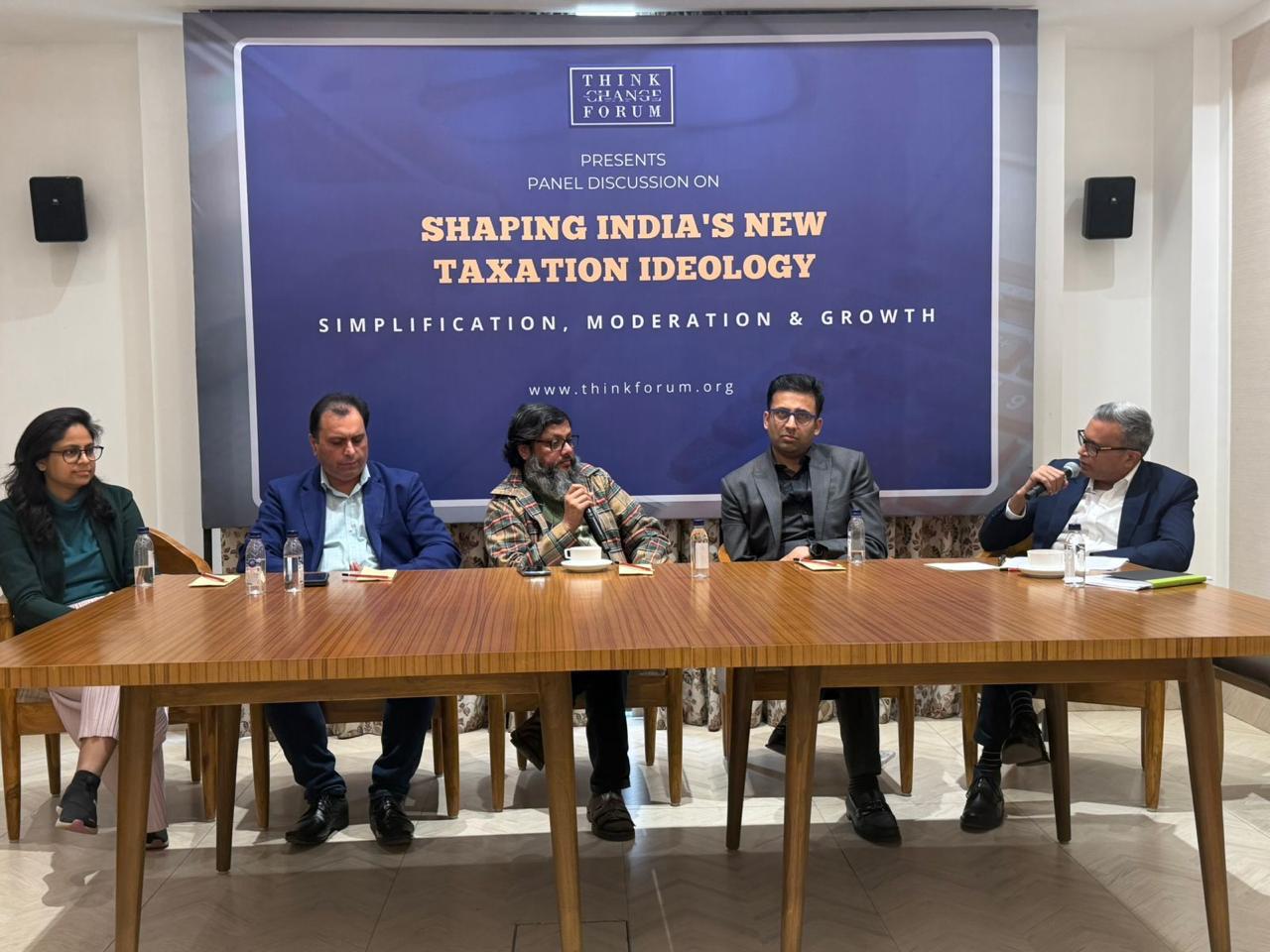
- Rajat Mohan: Senior Partner, AMRG & Associates
- Dr. Surajit Das: Economist and Public Finance Expert
- Yogendra Kapoor: Renowned CA, Author and Public Speaker
- Bhumika Verma: Indirect Tax Specialist
The central argument of the paper was that India stands at a critical fiscal inflection point ahead of the Union Budget, and must now extend the successful principles of GST reform to direct taxation, enforcement and investment policy. The paper made a compelling case that in high-informality economies like India, compliance elasticity outweighs rate elasticity meaning simpler and fairer tax systems generate broader participation and stronger revenues over time.
The paper also drew from ancient Indian fiscal philosophy, particularly the Arthashastra, which advocated for moderate taxation, situating GST 2.0 within both classical Indian wisdom and modern public finance thinking. The panel was of the view that tax moderation is not a concession but a growth strategy one that India must embrace with conviction as it prepares its next Union Budget.
Yogendra Kapoor, renowned CA and public speaker, was of the view that high taxes whether direct or indirect always encourage evasion and corruption. He said lower taxes widen the base and improve compliance, and that GST collections are rising precisely because the economy is formalising. He cautioned, however, that creating a new 40% peak rate would undermine the compliance gains achieved so far, and that ideally GST should be restricted to just two rates of 5% and 18%.
Dr. Surajit Das, Economist and Public Finance Expert, drew a historical parallel, noting that Kautilya in the Arthashastra proposed collecting roughly one-sixth of produce as tax approximately 16% and that India's current combined tax-to-GDP ratio is in that vicinity. He also flagged the investment paradox in the Indian economy, pointing out that while corporate profitability has improved over the past decade, profits are increasingly being channelled into financial portfolios rather than productive capacity. He noted that investment depends on expected profitability and confidence, and that if businesses perceive the future as risky or uncertain, they may not invest despite strong profits.
Rajat Mohan, Senior Partner, AMRG & Associates, challenged what he called a popular misconception that India has moved to a two-rate GST structure. He said that factually, the country still operates on a very complex multi-rate structure that is difficult for taxpayers to understand and comply with. He underscored that this complexity remains a significant barrier to the broadening of the tax base.
Bhumika Verma, Indirect Tax Specialist, noted that while GST 2.0 aimed to streamline inverted duty structures, the revised rate regime has in practice added new layers of complexity for industry, resulting in significant credit accumulation. She highlighted that MSMEs and young firms continue to bear the brunt of these structural anomalies, which effectively function as a hidden liquidity tax.
The panellists also raised concern about the direct tax base, noting that out of a population of 140 crore, only about 2.5 crore people are effective taxpayers a mismatch that points to gaps in enforcement and compliance rather than inadequate tax rates. The panel observed that high-value consumption continues to rise despite fewer direct taxpayers, reinforcing the need for technology-driven base expansion through better integration of GST, income tax and high-value consumption data.
The panel also flagged the risk of rising out-migration of high-net-worth individuals to low-tax jurisdictions such as the Middle East, underscoring the dangers of policy unpredictability in an era of mobile capital. The panellists agreed that India needs a distinct taxation ideology one that blends classical Indian wisdom with modern economic thinking, and prioritises moderation, fairness, compliance and growth over short-term revenue extraction.
The white paper concluded with the observation that as India approaches the Union Budget, the choices made on taxation will determine whether it becomes a catalyst for long-term economic expansion or a constraint on ambition. The panellists said that extending the reform momentum of GST 2.0 to direct taxes, investment incentives and enforcement in the near term will go a long way in broadening the tax base and boosting sustainable growth.